
 CIBIS International
Cessnock City Council Food Inspections
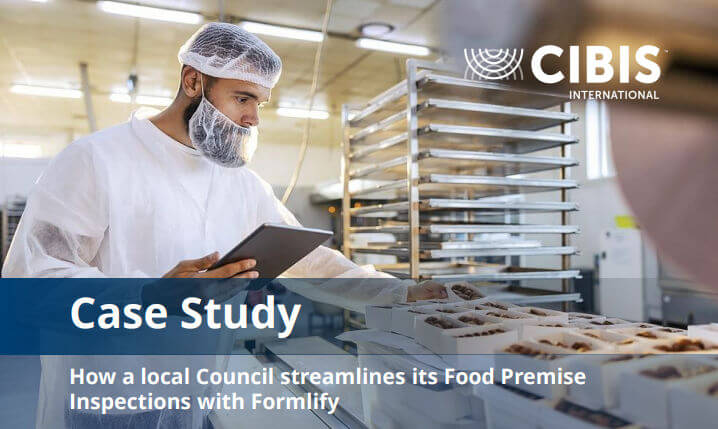
How a local Council streamlines its Food Premise Inspections with Formlify
Cessnock City Council is a regional local government authority (LGA) in New South Wales responsible for safeguarding public health across a diverse range of food premises, including cafés, restaurants, clubs, takeaway outlets, wineries, mobile food vendors, and temporary food stalls operating within their LGA.
Council’s Environmental Health Officers (EHOs) conduct routine, complaint-driven, and risk-based food premises inspections in accordance with the NSW Food Act 2003, NSW Food Regulation 2025 and the Australia New Zealand Food Standards Code, ensuring food businesses meet required health and safety standards.
Inspection PDF burden
With hundreds of registered food businesses spread across urban and rural areas, Cessnock City Council’s inspection workload is significant. The Council’s food inspections were previously completed using editable PDFs in PDF Expert on iPads. After each inspection, officers flattened the report and emailed it to the business owner and Council administration, where it was manually saved into Content Manager (TRIM) and processed for invoicing.
Photos were captured separately and embedded into reports where possible, often disrupting formatting and hitting limits on image size and number. In practice, photos were frequently sent as separate email attachments, creating fragmented records and additional follow-up work.
The approach introduced ongoing challenges:
- Inconsistent data entry and limited business rules
- Missed or delayed report distribution due to manual emailing
- Difficulty keeping templates up to date across officers
- High effort required to update forms when Food Authority requirements changed
- Overreliance on email for record management
Although Council transitioned some inspection types away from PDFs, the complexity of food inspection forms made them difficult to digitise internally. The final breaking point came when there was a change in platform which further reduced functionality, limiting photos, signatures, file sizes, and overall usability.
Finding the right digital fit
As Cessnock City Council explored other digital form options for food premises inspections, it found that many tools missed the mark. Generic form builders lacked the regulatory depth Council required, while specialised inspection platforms were often expensive and inflexible.
Council needed a solution that aligned with legislation and policy, worked reliably in the field (even offline) and could be easily updated as food standards changed, while ensuring consistent inspections across officers. Since they were already using Formlify for other business processes with proven success, they were keen on seeing if it could help them with this particular use case as well.
"Formlify allowed us to embed the legislation and our inspection procedures directly into the form which improved consistency and reduced the risk of missing critical compliance issues."
An important differentiator was that Formlify can automatically load the completed inspection reports into Content Manager and their Enterprise Resource Program.
Built around food safety compliance
Using Formlify digital inspection forms, Cessnock City Council was able to guide Environmental Health Officers through each inspection in a structured, riskbased way.
The forms can adapt as inspectors move through an inspection, prompting only the questions that are relevant to the type of premises and level of risk. Mandatory fields ensure critical compliance items are never missed, while built-in risk ratings and photo capture provide clear, auditable evidence to support inspection outcomes. Business owners can also acknowledge inspection results digitally at the time of visit.
Mobile inspections across the LGA
With Formlify in place, whether inspecting a café in town, a winery in a rural area, or a mobile food vendor at an event, officers can complete inspections online or offline as required.
Each inspection is automatically time and locationstamped, with photos captured directly against specific compliance items. Once connectivity is available, inspection data synchronises automatically, removing the need for manual data entry back at the office.
Food business operators benefit from clearer inspection outcomes and faster follow-up communication, improving transparency and understanding of compliance requirements.
Australian hosting & data security
Data security and privacy were key considerations for Council. Inspection data includes sensitive business and personal information, making Australian data residency essential.
Formlify’s Australian-based hosting ensures all inspection data remains within Australian jurisdiction and aligns with NSW Government and Council IT security standards. This reduces the risks associated with offshore data storage and provides confidence for Council’s IT, legal, and governance teams.
Three key benefits
- Consistency and audit readiness
All inspections follow the same structured, compliant process, making internal reviews and audits simpler.
- Offline capability
Inspectors can complete inspections in wineries, rural locations, and mobile food premises without connectivity issues.
- Ease of change
Inspection forms can be quickly updated when legislation, policy, or inspection priorities change without reprinting or retraining.
Early outcomes
Although the rollout is still evolving, Cessnock City Council has already seen clear benefits. Inspection administration time has reduced, allowing officers to focus more on frontline work, while critical noncompliances are being identified and followed up more quickly. The quality of inspection data has also improved, supporting better reporting and trend analysis and giving Council greater confidence in its regulatory enforcement.
“It’s still early days,” the supervisor noted, “but the efficiency gains and data improvements are already clear.”
Looking ahead
Formlify is currently used within the Environmental Health team for on-site wastewater inspections and business notifications. Council is progressively expanding its use to additional regulatory inspections and standard forms.
“I would confidently recommend this approach to other Councils,” a supervisor said, “particularly those balancing strong regulatory obligations with limited resources.”
Open PDF file to read more.